
Policy Effective April 1, 2026
A downloadable copy of this Policy Manual is available here: https://wearedcbs.com/wp-content/uploads/2026/04/dc-student-policy-manual-2603.pdf
General Course Policies
1.1 Submission Requirements / Late Policy
Assignments are due on the date specified in the activity instructions. To receive a grade, submissions should be complete and submitted on time. All submissions are graded for quality, accuracy, appropriateness, and completeness. Assignment submissions that do not follow the directions, required steps, or fulfill given project specifications will be marked according to the grading rubric for that course.
This penalty structure below applies to assignments with due dates in weeks 1 through 3 of class:
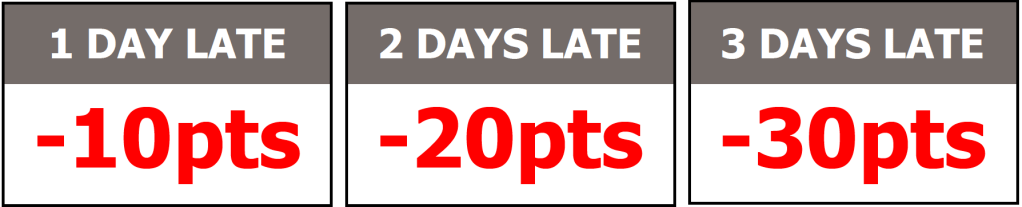
Acceptance of work after 3 days is at the instructor’s discretion and based upon course curriculum. A maximum score of 50% will be applied to the assignment.
The following are not eligible for late submission:
• Discussion posts, due to the interactive nature of discussion forums
• Tests / Quizzes
• Any assignment due in Week 4 of the course
Resubmissions, if accepted or required by the instructor, can be held to the late point deductions above.
1.2 Discussion Assignments
Discussion assignments may have a multi-part deadline, which may consists of an initial response post and peer response posts. This can vary depending on the course; refer to assignment directions.
Due to the interactive nature of discussion assignments, they are not eligible for extensions.
1.3 GPS (Global Professionalism Standards)
Instructors are to be contacted prior to an assignment due date if the due date cannot be met. GPS points may be deducted at the instructor’s discretion, as outlined in the Full Sail University Online Student Manual.
1.4 Absences & Extensions
To be considered for an assignment extension, instructors have the right to request absence documentation from the student. Extensions may be offered on a case by case basis. The instructor has complete discretion on whether to accept assignments or extend due dates.
Week 4 assignments are not eligible for extensions.
1.5 Live Meetings and Archives
Full Sail University uses Zoom software in order to facilitate live videoconferencing for lecture instruction, one-on-one training, and special events. To install Zoom on your phone, tablet, or computer, please use the Zoom Instructions on Full Sail One. For assistance on Zoom, please contact technicalsupport@fullsail.com.
In your classes, there will commonly be a Zoom Meeting at least once per week. Instructors may vary in their meeting times, so please check the LMS for the date and time (verifying your timezone) of the next meeting.
Requirements for Attending Meetings
- You are required to register with Zoom with your real name, not a handle or pseudonum, and using your Full Sail email address. This will allow the instructor and your fellow students to identify your attendance and participation in the meeting.
- While the camera is off by default, you do have the ability to turn on your camera. Instructors may require that you do so. Please maintain proper etiquette during the meeting, including wearing clothing that would be appropriate for an educational setting.
- Please keep your mic off unless told otherwise by your instructor. This prevents the class being disrupted from a noise on your side that the mic pics up.
Any activity, either through video, audio, or chat, that causes a class disruption, or violation of any policy over Zoom may cause GPS points to be deducted, or further measures to be taken.
Meeting Archives
Due to the flexible nature of online education, attending a meeting live is optional. However, viewing the information is vital to your success in the class! You are accountable for any information that takes place in the meeting in your courses. To view the Archive, visit the Recordings Tab under the respective meeting. If a meeting archive is not available, the instructor will provide a link to a previous meeting’s archive.
Meeting Absence Penalty
While there is no official penalty for not watching a given meeting live or in archive, there may be associative penalties incurred. These penalties can are enforced in the GPS assignment, and each penalty can be assessed per-incident:
- Inadequate research of needed materials for active participation -5pts
- Not following directions pertaining to required/requested materials and duties -5pts
- Lack of follow through on tasks for required/requested materials and duties -5pts
For any questions on this policy, please reach out to the instructor of the course.
General Course Policies
2.1 School-Issued Camera
Students in the Digital Cinematography Associates of Applied Science (and Bachelor degrees) are provided with a quality digital camera equipped to cover broad production and post-production requirements for filming course projects. Film and Video Certificate (Online) students will be guided in the use of non-school-issued devices by the course instructors.
Cell phone video is never accepted in lieu of the school-issued camera once that camera has been received.
Not following these rules for obtained footage can be considered Academic Dishonesty in accordance with the Full Sail Student Manual.
It is the student’s responsibility, upon receiving the school-issued camera, to care for and retain the equipment for all student projects. Students are required to film with their school-issued professional gear package through completion of their degree.
It is recommended that students purchase equipment and/or renter’s insurance to prevent delays in completion of their projects or degree in the event their camera is stolen or damaged. The university does not supply replacement cameras or equipment.
2.2 70/20/10 Rule Using School-Issued Camera
Workflow and course instructions are created and taught using the school-issued camera features. If a school-issued camera is not a part of the certificate or degree, then instructions for non-school-issued camera usage will be provided by the instructor.
It is required that at least 70% of any student project be filmed with the provided camera from the school-issued gear package.
Up to 20% of an edit’s total runtime may include footage shot on non-school-issued cameras of greater or equal quality. The camera must be pre-approved by your current instructor before the footage can be submitted.
Up to 10% of an edit’s total runtime may include obtained / archival footage with an accompanying signed release. Use of footage that is not your own must be declared in advance to your instructor.
Stock footage in this category must include a graphic on that footage that states “Footage courtesy of ____” or in the credits / references sheet, depending on project parameters.
Note: Depending on the parameters of assignments and projects, individual instructors and/or courses may not allow obtained / archival footage.
Footage that does not fall within these guidelines may result in a 0% for the submission.
3.1 Full Sail University Student Project Policy
from the University Student Manual
“The content of student project work must not contain any pornographic material, any material that would be considered offensive by the general public, sexually explicit material, or profanity.”
3.2 Digital Cinematography Department Student Project Policy
The goal of the department is to challenge students’ creativity and prepare graduates for a broad, universal career. Content will be reviewed by the Policy and Procedures Committee if a student believes content is within policy and seeks appeal. A quorum of educators will determine if standards have been met and directions followed. Justification may be required at any stage throughout the project.
Client-based projects are held to a high standard of international professionalism. In a student project, alcohol, drugs, weapons, violence, or sexual material of any kind cannot be depicted. The word “violence” is defined in the Oxford English Dictionary as behavior involving physical force intended to hurt, damage, or kill someone or something. Such content can be presented to the Policy and Procedure Committee for review if the student has ample justification for its minimal depiction.
This Content Policy is the minimum requirement. Instructors, acting as client, may impose greater restrictions, with respect to their course goals.
3.3 Summary: Why Are These Policies In Place?
As a filmmaker, no matter what your position in the production…
SAFETY SHOULD ALWAYS BE YOUR HIGHEST PRIORITY
Not only your safety, but also the safety of the people you are working with.
The Digital Cinematography Department’s content policies were initiated with such safety goals in mind. Without lengthy training or hired professionals on set, the program must limit the types of activities that can be done within student projects.
As a student who is learning the craft, there are many things that will occupy your time on a shoot. We have determined that the vigilance required for properly handling weapons, stunts, and train tracks – for example – would eclipse the other important aspects of the filmmaking process.
3.4 Representation of Illegal Acts
Students may not plan, pitch, or submit footage that depicts or describes nonfictional illegal acts.
Students who are unsure about this should speak with their instructor ahead of time, prior to filming.
Students who have witnessed crimes or the admission of illegal acts in the course of their productions should report it to the proper authorities immediately.
3.5 Film Permit Disclaimer
Students are expected to obtain a film production permit for all student productions, if needed, in accordance with the jurisdiction of the filming location.
Students understand that they are not protected under Full Sail University’s insurance policies and are thus responsible for personally obtaining any necessary permits and/or liability insurance needed to execute their project. Failure to obtain a permit and/or liability insurance will not affect the grade in any assignment, but could expose the Student to personal legal liability and/or other risks, and is directly against the advice of Full Sail University. Please reach out to your local film office to determine local guidelines / regulations in your area.
3.6 Spectator Rule
If you are considering filming a demonstration or live event, there may be some allowance to these rules at the instructor discretion.
The following must be true for the Spectator Rule to apply:
- You have discussed the scene or concept with the instructor, and have received their approval in advance
- The demonstration or event would have occurred without your filming it
- You are not directing the action or interacting/distracting the participants in any way
- You are not filming in an area that that would mark you as a participant in any respect (being in the passenger of a rally car in the Baja 1000 and operating a camera, be it handheld or remote)
A dramatization of a real life event does not qualify for the rule.
3.7 Alcohol and Drugs
Members of the Full Sail Community must not be in possession or under the influence of alcohol or illegal drugs nor provide others with the same. When distributing material depicting alcohol/drugs, standards require a commercial audience to be over 21 years of age. Because the target audience cannot be controlled or predicted in the academic setting, and students under legal age are to be considered part of your peer audience, the following guidelines will be enforced for all student work:
ALCOHOL, AND OTHER FEDERALLY LEGAL SUBSTANCES
For all federally legal substances, such as alcohol, representation in a student project will be permitted, as long as there is NO CONSUMPTION shown or planned.
For projects depicting alcohol shown but not consumed on screen, students will need to complete an additional waiver after instructor approval. Please consult with your instructor beforehand.
This is a link to the Alcohol Waiver: https://wearedcbs.com/wp-content/uploads/2025/05/alcohol-presence-in-production-waiver-2507.pdf
Students should not show alcohol branding or labels (such as: in a bar scene) as this is a copyright violation concern.
Example: Students may show a glass of wine sitting on a table (if motivated by the storyline) but may not show the talent drinking from the glass.
DRUGS
Representation of illegal drugs or drug paraphernalia is NOT PERMITTED, with no exceptions. Prescription drugs may be used as background set dressing, but their labels must not be shown, and they cannot be interacted with by the actor in any way.
MARIJUANA
Representation of Marijuana or marijuana by-products is NOT PERMITTED, including using dispensaries, smoke shops, growing locations, or other establishments as filming locations. This restriction also includes any CBD oils or other substances with any amount of THC. Marijuana is not presently a federally legal substance, and may be illegal depending on the state.
NICOTINE
According to federal regulation, consumption of nicotine by of-age parties will be permitted on screen in a student project when the student includes the following disclaimer in their submission / credits:
“No person or entity associated with this film received payment or anything of value, or entered into any agreement, in connection with the depiction of tobacco products.
The depictions of tobacco smoking contained in this film are based solely on artistic consideration and are not intended to promote tobacco consumption. The Surgeon General has determined that there are serious health risks associated with smoking and secondhand smoke.
If you or someone you know is struggling with smoking please visit https:// smokefree.gov“
Nicotine use should be character-driven and can not be used for advertising purposes.
3.8 Profanity and Explicit Language
The Motion Picture Association of American (MPAA) and the Federal Communications Commission (FCC) have set strict ratings systems as to what is permissible for films and television. In consideration of all distribution methods, the policies for student content are based on the guiding principles of PG-13 and TV-14 – set by the MPAA and the FCC respectively.
The Digital Cinematography Department has adopted the following policies for Profanity and Explicit Language:
- The use of profanity / expletives that are not of a sexual manner MAY be permitted in some projects, when used sparingly and appropriately. Please refer to your individual project guidelines or reach out to your Instructor for clarification.
- Profanity is defined as: use of a swear word or irreverent language that can be abusive, vulgar, or used in contempt. (Merriam-Webster)
- Slurs or negative colloquial references are never permitted. This may include but is not limited to: racial, ethnic, gendered, transphobic, age, religious, or any other abusive or threatening speech that expresses prejudice against a particular group or individual.
- Sexually explicit language is never permitted. Sexually explicit language is defined as any direct reference to a sexual act. This includes direct statements of the act occurring, descriptions of the act, or any innuendo that can be construed as a sexual act.
3.9 Weapons and Dangerous Objects
The use of real or prop weapons is strictly prohibited in any and all student assignments.
The degrees will NOT ALLOW the visual depiction of any weapons, props, or other objects whose intention in a scene is to cause harm (hereinafter referred to as “dangerous objects”).
Any dangerous objects found in student submissions must be removed from the project or receive a zero for that assignment. This policy also extends to all pre-production planning, and prohibits plans to show any visual depiction of dangerous objects in pre-production documents (such as: Scripts, Shot Lists, Mood Boards, Treatments, Storyboards, etc).
WHAT IS CONSIDERED A “DANGEROUS OBJECT”?
The sole consideration is how the object is used, either explicitly or inferred. This means that simply having an object around might not warrant it to be called a dangerous object – it is how it is used, or intended to be used, in the script or footage. Below are examples of identical objects used in ways that would be allowed/not allowed:
NOT ALLOWED – A butcher knife in the hands of a killer stalking a victim
ALLOWED – A butcher knife used to chop meat for a webisode on how to make Hungarian Goulash
NOT ALLOWED (Even if nothing else is shown) – Villains with baseball bats surrounding a new guy in the park, with one of the villains saying “You are going to regret coming here”
ALLOWED – The third baseman picks up a baseball bat and points it toward center field before stepping up to the plate to swing
NOT ALLOWED – Washing a child’s mouth with soap because they said a curse word
ALLOWED – Demonstration on how to wash your hands with soap and water
Firearms (or objects that “look” like firearms) are NEVER ALLOWED as props or wardrobe. Anything that fires a projectile and may cause injury is not allowed.
Note that this policy only applies to VISUAL DEPICTIONS of dangerous objects. The examples below are adult situations, but do not have dangerous objects.
ALLOWED – Gunshot (sound effect) with flash (special effect or visual effect) seen under a closed door
ALLOWED – The silhouette of the killer, lording over the screaming victim after he has trapped her in a corner
ALLOWED – The hero bleeding on the ground after the villains got to him
Although the examples above are allowed in the context of a visual depiction of a dangerous object, they may be denied due to excessive violence or gore.
It is up to the instructor reviewing the submission to determine if the content has a dangerous object.
Exceptions to this policy may be made for pre-existing set decoration of weapons (example: mounted on a wall). There must be no physical contact with a weapon or prop weapon permitted before, during, or after a student production for any reason at any time.
3.10 Pyrotechnics/Use of Fire
No pyrotechnics of any kind will be permitted in a student project. This includes but is not limited to any open flames.
Below are examples of what is allowed and not allowed WITHOUT INSTRUCTOR APPROVAL GIVEN BEFOREHAND:
NOT ALLOWED – Setting off a firework of any kind
NOT ALLOWED – Campfires
NOT ALLOWED – Actor holding lit torch
NOT ALLOWED – Actor lighting a candle or match
NOT ALLOWED – Stovetop/grill cooking
3.11 Stunts
The Digital Cinematography Department does not allow stunts of any kind.
A stunt may be defined as: any act or physical feat that has the potential to cause harm to the participant or others. This may include staged combat.
What constitutes a stunt is ultimately up to the instructor. If you are unsure if a planned action will be classified as a stunt, contact your instructor prior to moving forward.
3.12 Moving Vehicles
Students planning to use moving vehicles within class projects will be held to the highest expectations for safety and professionalism.
A moving vehicle is defined as: any vehicle or machine that is propelled, driven, or drawn by mechanical power and COULD be used on public highways, roadways, or waterways.
The use of moving vehicles is allowed within student projects, with the following limitations:
- The person operating the camera can NOT be the person driving.
- While the vehicle is in motion, there should be no directing or distractions to the driver.
- All participants must obey driving laws at all times; no driving dangerously.
- All rough clips must have their AUDIO ON. Instructors may request raw footage.
- Individuals / equipment may not be in the direct or potential path of an oncoming, moving vehicle. Examples include filming from: parking lots, shoulder/curb of roadways, or on medians.
3.13 Train Tracks
Filming or photographing on property containing TRAIN TRACKS, TROLLEY TRACKS, SUBWAY TRACKS or any similar rail passageway intended for moving vehicles is strictly prohibited for use in any student project.
Restriction extends to scripts and pre-production planning materials referencing such content
Student content not adhering to this policy will not be accepted for scoring credit
Content representing Talent on or directly adjacent to tracks will also incur a 100pt penalty on their class GPS grade
If interested in requesting an exception, you must receive approval from your instructor. If the exception request is granted, an approved Film Permit and Location Agreement is required during the pre-production period.
Questions?
If you have questions regarding appropriate material, please consult with your current instructor for guidance. Please note your instructor will have final resolution as to the content permissible in his/her class. Penalties may be applied for violation(s) of the above rules up to and including rejection of the content and receiving a zero for the relevant assignment(s).
Academic Integrity
4.1 Academic Dishonesty
Our students are expected to have integrity at all times here at Full Sail University. This is especially true with regard to their academic performance, including the submission of creative work and assignments as well as test-taking in the classroom. Obtaining credit for work that is not a student’s own is academic dishonesty, discredits the integrity of the university as a whole, and will not be tolerated. Below are guidelines and consequences that are important in ensuring success during a student’s tenure at Full Sail University.
Academic dishonesty can be cheating on tests, projects, papers, and homework. This includes, but is not limited to plagiarism, misrepresentation, and unauthorized (uncited) use or possession of material. This also includes any student who shares his or her work with the intention of helping another student to cheat. Unless specified in the assignment or by the instructor, collaboration is not allowed, and this student is subject to the same penalties as the person who plagiarized.
Projects/Assignments
Students are expected to be honest and produce their own projects / assignments according to the specifications of the curriculum. They must work solely on their projects / assignments unless otherwise noted in the assignment. Work submitted by our students is assumed to be a student’s own thoughts, ideas, and words. Discovery of the contrary will result in immediate consequences. For group projects, all students whose names are submitted with the project are responsible for the content and will be subject to disciplinary action should plagiarism be discovered.
Test-taking
Students are expected to complete all tests/quizzes on their own. Discovery of the contrary will result in immediate consequences. For group projects, if your name is on the project, you are accountable for information turned in.
4.2 Copyright
Full Sail is committed to complying with all applicable laws regarding copyrights. Copyright protection exists in “original works of author–ship fixed in any tangible medium of expression, now known or later developed, from which they can be perceived, reproduced, or otherwise communicated, either directly or with the aid of a machine or device.” The copyright exists from the moment the work is created even if there is no copyright notice on it.
The following types of works are copyrightable:
- Literary works, such as books, journal articles, textbooks, laboratory manuals, lectures, and computer programs;
- Musical works, including any accompanying words;
- Dramatic works, including any accompanying music;
- Pantomimes and choreographic works;
- Motion pictures and other audiovisual works, such as films, videotapes, videodiscs, or multimedia works;
- Pictorial, graphic, and sculptural works;
- Sound recordings, such as audio tapes, audio cassettes, phono records, or compact discs; and
- Architectural works.
Most works written in 1922 or earlier are copyright-free; this does not apply to sound recordings, most of which are still covered by some form of copyright. “Royalty-free” does not mean “copyright-free;” it just means you don’t have to pay for ongoing use once you have paid the initial license fee. Copyright protection does not cover ideas or concepts on which a work is based, but rather the unique manner in which those ideas are expressed.
If an instructor allows use of copyrighted materials, copyright owners MUST be credited, and used with expressed permission. (Cite your sources!)
4.3 Trademarks / Servicemarks
Brands, business names, logos, slogans, and other devices used to identify and distinguish the brand from competitors in the marketplace may be protected by trademark law. This can include distinctive building interiors and product packaging. Trademarks can be used in expressive works such as movies without needing to get permission as long as they are being used in a manner that merely depicts reality and is not misleading or indicative of a sponsorship or affiliation between the brand owner and the filmmaker or production. An instructor may require permission from the trademark owner be obtained prior to use in a student work.
4.4 Right of Publicity
Various states have laws that prohibit unauthorized commercial use (e.g., promoting a trade, business or commercial activity) of a person’s name, picture, likeness, voice and other factors. This is a right that exists independently of the copyright in the photograph, audio or visual depiction that’s being used. In some states, even non-human elements that are closely associated with a particular individual may create publicity rights that need to be released, if people in the industry or outside it could identify who the person is simply by hearing or seeing the material in the final production. For example, a race car might be identified with its driver, a slogan may be associated with the person who repeatedly says it, character makeup may indicate who the makeup artist is, or a sound-alike might bring to mind a particular singer. The Digital Cinematography Department requires that permission be obtained from any person whose voice, image, picture, likeness or other identifying aspect is used in a student production.
4.4 Artificial Intelligence (AI) Use
No unauthorized use of Generative AI (artificial intelligence) tools, such as ChatGPT and Firefly, for any submission, class assignment, or discussion board.
Prohibited usage includes, but is not limited to: written text, generated still or video imagery, and/or Generative AI assisted video editing.
AI tools can only be used in the classroom when the instructor has given expressed permission to do so, or it is clearly written in the assignment directions. Even then, students are required to acknowledge use of Generative AI in any work submitted. Generative AI content must be properly cited. Failure to do so will fall under the Full Sail Academic Dishonesty policy. Instructors may require students to clarify their sources or resubmit concerning assignments.
If students are unsure about whether collaboration with others, including artificial intelligence, is allowed for a school assignment, they should contact the instructor PRIOR TO submitting work.
NOTE: All of the policies contained within this document will apply to all assignments and courses within the Digital Cinematography Department. This includes pre-production documentation, production / footage, and post-production edit submissions.
All students understand and agree to submit assignment materials that are in compliance with the Digital Cinematography Student Policy Manual.
Unless otherwise noted, all images in this manual are licensed through Adobe Stock, with permission of the creators/rightsholders.
END OF DOCUMENT
 Digital Cinematography